Gatekeepers vs. Gatecrashers: Our Global Theme

Gatekeepers vs. Gatecrashers: Our Global Theme

New York, NY – It’s a pleasure to announce the theme for our upcoming global Influencer Conference series. Developing a theme takes time, and countless fits and starts until you land on a concept that “feels right”. In order to accomplish that, the theme must be relevant to all our audience, our partners and align with our values. I think we have managed to do that and much more.

Our theme is “Gatekeepers/crashers: Thriving or Dying?” You can read our descriptive brief here:

The advent of technology and digital media was supposed to herald the end of the age of gatekeepers. The 21st century promised the democratization of communication and access.
Now, almost 15 years into a new century, it begs the question whether that has that truly been the case? Has the power and privilege of gatekeepers subsided or, has the expansion of technology actually had the opposite effect, increasing their reach and power?

For all of the talk of the democratization of the creative process, gatekeepers are more firmly entrenched than ever. How do creators of arts based culture navigate and succeed, as the gates get higher? How do well-meaning gatekeepers connect to and enhance existing cultural ecosystems? We pull the covers back and reveal the true machinations behind culture, commerce and influence by bringing gatekeepers and gatecrashers face to face…a modern day showdown between new age Visigoths and their roman emperor counterparts. 

Friction between gatekeepers/crashers lies at the center of our creative, social, and economic lives. In fact, one could argue as sector and industry designations blur it is more of a challenge to determine who serves which function. In fact, one could argue that at different times and under different circumstances organizations and individuals can wear both hats.

The recent Supreme Court decision of McCutcheon v. FEC and the F.C.C’s flagging interest in protecting net neutrality highlight how precarious the common interest are relative to corporate design. Cultural spaces are not immune as music, film, and other creative endeavors have more participants than ever giving the appearance of democratization even as they wrestle with fewer effective channels to gain traction and attention for their work. Even an artist as prolific as Kanye West feels constrained in his creativity. In an interview with radio/TV Host Sway, Mr. West details the frustration he encounters dealing with gatekeepers. The back and forth between the two men, which is sometimes contentious highlights the yin and yang between creativity, commerce and access. This brought home how important this is. If a globally relevant artist like Kanye is dealing with these issues, what about the rest of us?  In another telling quote Kanye West says this

“It’s mixing creativity with the fight like an athlete. Like it’s okay for the athletes to fight and push it, but they want the creative people to shut-up and be quiet. But these are the people with the real ideas that can actually change, can reorganize, can design cities, can restructure a curriculum, you know, can make life easier. And that’s the part of the game I want to be in: the making life more awesome.” October 28, Los Angeles’ 97.1 AMP Radio

“Creatives” are fighting to be heard, but who are they fighting against (or for), and why? Over the next few months through salons, essays, and finally our global conference we’ll confront the shifting landscape between gatekeepers/crashers across industry and creative disciplines in order to map our collective future.

Welcome to the journey.
This Is a Cliché

This Is a Cliché

There isn’t anything here you haven’t heard before. Consider it fair warning that likely there will be no incredible gems of wisdom to be gleaned from this note. A cliché is like an old, familiar blanket we wrap ourselves in to feel comfortable. We take comfort in a maxim that on some level makes sense; it’s been repeated ad nauseam and has become a part of our psyche. It is tempting to dismiss a cliché for those reasons. To do so however, we run the risk of missing some truths that can make for a richer life experience. I want to spend just a bit of time talking about life, death and failure.

“Live each day as if it’s your last. No one is promised tomorrow”. I am not certain those should be combined as one proper quote but we have all heard this (or some version of it) before. It is a cliché. Until it becomes relevant to you. Just yesterday I received news that one of my line brothers passed away. When confronted with the death of someone close it’s amazing how many emotions you process in a short time. Shock, sadness, confusion, and fear all come in ever increasing waves, which leave you disorientated, and searching for answers. Answers that will either never come or will fail to soothe the pain. Over the years I have lost friends to tragic circumstances. It’s always tragic when you are young and bursting with possibilities. It is never easy and each situation carries its own burden, its own weight, and its own terrible uniqueness. I now bear the weight of missed opportunity and a deep abiding regret at not having forged more regular connections with my line brother. A regret intensified by the certain knowledge that it is now too late. I failed to heed the simple lesson of the cliché offered above. I know my time here on Earth is finite but I behave as if it is not. I put things off for a tomorrow that might never come. My failure comes in not pushing harder to make these days sweet even when they appear to be intractably bitter. The bonds between my line brothers and myself were forged twenty-two years ago as young men pledging on Howard’s campus. The challenges and stresses we faced were only overcome because we sacrificed and loved each other as we loved ourselves. We became brothers all those years ago, committed to one another till death but in no way imagining death would claim one of us so soon. Where we once marched as ten we now stand as nine. There are difficult days of mourning ahead. But from the mourning comes new opportunities. There is fondness in the recollection of college days that swiftly pass. There is a chance to embody that cliché and live each day as if it’s your last. To is a chance to strengthen relationships that might have grown weak. To is a chance to forgive past slights to gain a lighter spirit. To is a chance to love each other messily and completely because we are not promised tomorrow but we are here today.

Dedicated to my line brother Snirly “Chuck” Simpson 5-Beta-92

Red Pills Unite! Good Riddance Jedi

Red Pills Unite! Good Riddance Jedi

“Try not. Do or do not. There is no try” – Yoda

“You take the blue pill, the story ends, you wake up in your bed and believe whatever you want to believe. You take the red pill, you stay in wonderland, and I show you how deep the rabbit hole goes.” – Morpheus

The Star Wars series and its accompanying mythos has become one of the most popular and referenced stories in the world. There is scarcely a place where people are not familiar with at least the basics of this world. It is the classic good versus evil story. The upstart, scrappy Jedi warriors are the defenders of all that is good, with high-minded ideals and powers that allow them to use the mystical energy of the Force. The evil, as personified by villain (and then redemptive hero) Darth Vader, use the Force as well but theirs is a twisted art popularly known as the “dark side of the Force”. Since Star Wars ascension into pop culture this language has become the metaphor of choice in describing business culture. Startup culture in particular is attracted by the rebellious, against all odds coda of the Jedi. The “new agey” nature of the Force appeals to those gurus and mystics who are seek answers in the onscreen lessons of Jedi Masters like Yoda and Obi-Wan Kenobi. On the surface, all of this seems harmless. What does it matter if some random entrepreneur describes himself as a Jedi, using his hard won mastery of the Force to create the next dating app? How many people have referenced the above quote by Jedi Master Yoda to focus their energies and push through boundaries? As a self-described nerd and fan of all things Star Wars, I too have been inspired by this fantastic world. I believed being a Jedi would be one of the most amazing things ever. It’s only more recently that I have come to realize I don’t want to be a Jedi. Though portrayed as the heroes in the films, the Jedi actually suffer from deep flaws that contributed to their demise and the downfall of the Republic they were sworn to protect. The Jedi were so assured of the correctness of their position they failed to realize they personified many of the problems they wished to solve. I have now come to realize that the Matrix is a better metaphor for a culture of change that is essential to solve daunting societal issues. The blue pill/red pill dynamic of the Matrix is far more relevant to those who are on the front lines advocating for change and reform in our current structure. In the Matrix, the hero Neo realizes that the entire world he has known is actually a construct of machines. The real world is long dead, the machines have taken over and keep humans in a dream like state where they live lives they believe are real. They do this in order to serve as living batteries plugged into the Matrix providing the machines with power. Very few in the Matrix sense that something is off, fewer still are identified and given the choice that Morpheus gives Neo. Take the blue pill, and remain asleep or take the red pill and enter the “real world”. Taking the red pill and unplugging from the Matrix immediately drops you into a harsh, unforgiving reality where you represent a threat to the very existence of the Matrix.

The Jedi mythology is easy, heroic and by extension seductive. Who wouldn’t want to cast themselves as enlightened monk-like warriors? But with a closer look, those before mentioned flaws are more nagging. The Jedi are the sworn protectors of the Republic. The Republic they are tasked to protect however is crumbing and corrupt. The Jedi spend little time, debating on whether the system they are fighting to protect is worth the effort or whether their considerable talent and skills should be used to build something new. Though they mean well they prop up the existing system and benefit from the status quo. Jedi are dogmatist; their belief system trumps anything else…unless of course it conflicts with their allegiance to the existing power structure. In that case, their belief system is second; maintaining the status quo always comes first.

Contrast the Jedi mythos with the liberated humans in the Matrix. The world of the Matrix is a more realistic portrayal of what life is like for those who are breaking the rules. The rules of the Matrix (the program) run on a set of presets that are meant to do one thing, control the population. Freeing yourself from the Matrix requires 1. Recognition of the existence of the Matrix (even in the abstract) 2. Commit yourself to becoming free from the Matrix (a one way decision) and 3. Commit yourself to building a new system that is wholly incompatible with the existing system. These options are not easy, nor are they glamorous. In fact, they are fraught with danger. The real world is not sexy. It’s dirty, the food is disgusting and your life is under constant threat by those who have a vested interest in keeping the Matrix intact. Sound familiar? Every great idea, every leap forward is a result of either perceiving the world in a different way or being in opposition to the status quo. It is not enough to ask questions, but one must ask the right questions in order to solve serious problems. We need more “red pills” that are committed to examining the very real structural issues of privilege, wealth inequality, gender bias and faux diversity that hold back true innovative progress that benefit all of us. So my choice is to turn away from the Temple, toss away the light saber and grab the red pill. The real world is waiting….

The Myth of Scarcity

The Myth of Scarcity

“Life is this simple: we are living in a world that is absolutely transparent and the divine is shining through it all the time. This is not just a nice story or a fable, it is true. ” Thomas Merton

There just doesn’t seem to be enough. Enough time, enough money, enough of this, or enough of that. If you’re like most of us, with long daily “to-do” lists, and seemingly endless appointments and obligations it seems as if there is never enough time to do the things we need to. In many ways, we have become conditioned to believe that the things we need most are in short supply. It’s important to address these feelings of scarcity because in turn it will effect how we view the world and our place in it. If we internalize this idea that the things we need are in short supply it supports the current zero sum mentality you find everywhere. Like an oxygen-depleted tank we begin to take short breaths with our very lives. Preferring to hoard for fear of not having enough. A win for you, in the zero sum model, becomes a loss for me. In an environment of perceived scarcity there is no room for collaboration or authentic connection. It is you against me and vice versa. This is a dangerous worldview as it restricts our solutions to real problems to the existing broken paradigm. If we are to make substantive changes to how we construct our perspectives we must address the myth of scarcity.

In reality, resources are not scarce at all. It is our warped perception that makes it appear so. On a macro level, the planet is more than capable of supporting our needs. Waste rather than scarcity is a far more significant problem even with something as serious as our food supply. In the marketing/advertising game, lack of budget (client mandated scarcity) is hardly a problem as global adverting spends reached an all time high in 2012. So if the facts don’t support scarcity then what’s gone wrong? Simply put, our zero sum attitude, fueled by perceived scarcity prevent us from combining intellectual, physical and economic resources for fear of “losing”. If you perceive my success as being opposed to yours how can we partner to create something new that could actually be mutually beneficial.

The world is bountiful and we should view it through those eyes. The things we need to make our lives productive and worthwhile are here in abundance. Love in all its facets, love for each other, love of what we do, love of our potential to create great things are all overflowing. We need only to embrace a different outlook and throw off this notion of scarcity. This single act is not a cure all. But it does allow us to begin to build new processes, new institutions with a clean slate. After all, what is there to be afraid of if there is nothing to lose?

In Each Other We Trust

In Each Other We Trust

When I was in business school at Duke University we didn’t talk much about the idea of trust. We emphasized teamwork a ton, and actually the “Team Fuqua” culture was a huge part of my decision to attend school at Duke and I loved every minute. One could say that the idea of a team culture implies a trusting culture. After all, can teammates work effectively if they do not trust one another? Lack of trust between teammates can make it a harder road but it won’t necessarily doom the team to failure. The reality is many teams in academia or in traditional workplace environments are hoisted upon us. We don’t make the choice to team up, so the team whether dysfunctional or not must find a way to produce “something” even if that output is not the potentially best result. My point is that even in a leading institution like Duke, with a strong culture of teamwork doesn’t directly address the concept of trust. This is not unusual as a discussion of values, whether trust, sharing, collaboration, love are not usually front and center in the “alpha-type” construct of business and its training ground, business school.

It is outside of a traditional corporate environment that trust must be one of the most important working facets of any relationship. In fact, it is likely #1. Relationships are ultimately about how we choose to transact with one another. The classic language of “give and take” is a simplistic rendering of a relationship. Beginning a relationship with a foundation of trust has the power to place into motion meaningful actions that will drive the success of that transaction. Too often we think about our transactional future in terms of devices, speed of transfer of data, or the language of contracts. Our transactional future turns most significantly on how we choose to interact with one another. That begins with whether or not we value trust as a key component in our interactions.

Trust is both the easiest and scariest thing one person can do. Trust requires you to be open. If you are open, you must be vulnerable. Our fear of being vulnerable comes from a fear of being hurt, or taken advantage of, or duped. If we confront this fear we will find we have the capacity to be comfortable within our vulnerability and draw strength from it. Trusting becomes an active choice in the faith of other human beings to not harm us. Our transactions can now come from a place of bravery rather than fear providing a much stronger foundation. The old model of transactions is fear based. We enter relationships, thinking about what we have to lose, how can we get hurt, how do we protect against the “down-side”? Trust makes us work to keep the fear at bay. Bad things can and always will happen but it shouldn’t color the way in which we treat one another. In an increasingly fragmented creative world, it should be a core operating strength that smaller organizations work together. Big organizations have the advantage of resources and scale. Smaller organizations should build coalitions of trust in order to create better work and establish better working economies for themselves. Instead smaller organizations often act like serfs toiling on the land of the corporate landowner. At a time in history when our goals have never been more aligned many are resistant to scrapping the old “fear based” ways of working and creating. If we can embrace trust as a starting point to forge a different transactional future we can go a long way toward creating a new normal that is braver than the old.

Feminine Values & Gender

Feminine Values & Gender

Each day I feel there are new conversations and opinion pieces that tackle the idea of feminism and what it means to have an inclusive society. I have good friends that do great work in this arena advocating for the inclusion of women and their perspectives in a myriad of fields that currently do not include much diversity. I applaud and support those efforts but I do believe we need to shift the conversation in a different direction. Instead of seeking out representation based on gender we need to focus on representation based on values. The idea of promoting feminine values, among them empathy, collaboration, and sharing, in order to create better institutions is critical to move the world forward to a more inclusive and just future.

When I was a kid my mother had an old saying “Your color isn’t always your kind”. What this simply means is that just because someone looks like you doesn’t mean they are like you. These flimsy shells of different colored skin and boy or girl parts that we obsess about only tell part of the story. They are easy identifiers that we all use to assign group identify and superficial behavioral traits. We must go deeper and establish a link to our values. The beliefs that we hold dear and align ourselves with carry more weight than almost anything else we encounter. It is increasingly important to find, connect and share with those who embody the same values. In the case of feminine values, the challenge is if we triumph only gender we assume that biological similarity will equate to shared perspective. This is not always the case.

The recent work by author/consultant John Gerzema “The Athena Doctrine” researches these values from a global perspective. He interviews men and women who subscribe to feminine values to build coalition and drive change. The work of Leonard Schlain examines our philosophical and cultural history and relationship with femininity in his seminal work The Alphabet Versus the Goddess. Both authors frame their work from a values based construct rather than a gender based construct.

During our upcoming Influencer Conference NYC, we will be discussing feminine values in a conversation titled Embrace the X: How Feminine Values Will Save The World. We invite you to join us in this discussion by registering for Influencer Conference NYC this coming Nov 6th – Nov 8th.

Why Mindfulness

Why Mindfulness

Over the years of producing Influencer Conference we have settled on a core group of values that inspire and guide us as a company. Our premise is simple. We believe that values, the things we care about and drive our passions are more important that our vocation, the things we do. These values shape the agenda, speakers and audience of each conference.

Explaining mindfulness and why we include it among our core values is pretty easy. During 2012’s conference I remember looking out at the crowd and seeing a sea of blue glowing screens. Laptops, tablets, smartphones all lit up signifying people were firmly plugged in, communicating with someone or something but not actually “in the room”. I was struck by this, because we take great pains to curate an event that would be interesting, thought provoking and beneficial. The audience confirmed their interest by purchasing a ticket, so clearly they agreed. Yet, here we were in a room together and apart. I thought to myself, are people paying attention? Are they listening to the discussion or merely waiting for the next soundbyte to be shared via social media? These questions remained with me post conference and it was shortly thereafter I made a decision to encourage our platform to move to one that emphasized mindfulness. I have practiced yoga and Vedic meditation for a few years and both practices have become increasingly important in how I harness my creative energy and manage stress. Now, that doesn’t mean in order to be mindful everyone has to do either of those two things (though we encourage it!). What we mean by mindfulness, is removing distractions in order to be fully engaged in the present circumstance. As a result, we are now asking that guests refrain from plugging in while talks are in sessions.  The value lies within the room, being present, not outside in the technosphere.

The commitment to mindfulness is a challenge as sponsors and partners partially determine the value of their participation by social media metrics. We respect that. We just don’t agree it is the standard by which we should measure the success of our event. We’ll continue to ask that our guests pour their attention, creativity and uniqueness into the room rather than outside of it.

This year we tackle this topic more in depth with the panel discussion: Present Tense: How Being Mindful Drives Creativity.

You can register here for that talk or any of our other panels via our website here.

And if you want to check out a cool introduction video to Vedic Meditation and it’s benefits take a look at this clip shot by Vedic & Yoga Instructor Light: 

The Manifesto of a Silo Smasher

The Manifesto of a Silo Smasher

I was asked to write this in 2011 by friend and author Kyra Maya Phillips. It was part of a project to inaugurate the opening of Hub Westminster in London. I was excited to share my ideas on designing a present and future that we can be proud of. The fruit of that labor is below and it’s the first time it’s been published outside of the Hub. Hopefully there will be nuggets that can help shape and sharpen your passion. Enjoy and build.

The Manifesto of a Silo Smasher

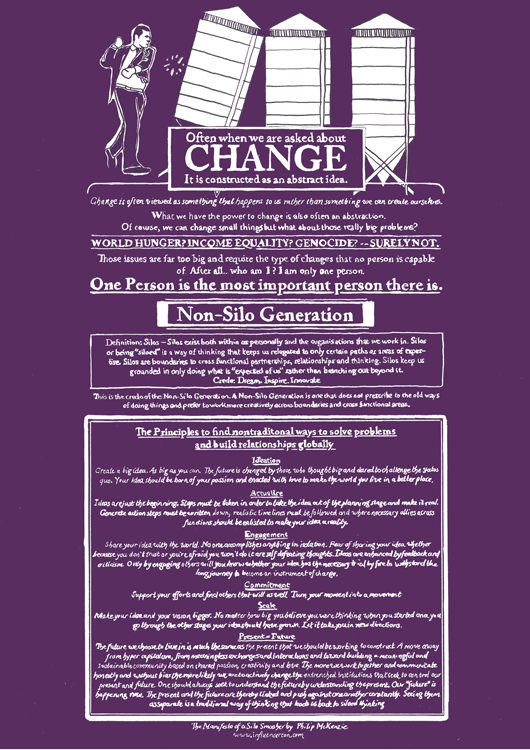
Often when we are asked about “change” it is constructed as an abstract idea. Change is often viewed as something that happens to us rather than something we can create ourselves. What we have the power to change is also often an abstraction. Of course, we can change small things but what about the really big problems? World hunger? Income inequality? Genocide? Surely not. Those issues are too big and require the type of changes that no one person is capable of. If they are attempted better to be attempted by someone other than myself. Because, after all..who am I? I am only one person. But with a new manifesto with a new way of looking at the world you can realize that “one person” is the most important person there is.

My Manifesto is that of creating a new way of thinking personally and organizationally and it is designed for the “Non-Silo Generation”.

Definition: Silos – Silos exist both within us personally and the organizations that we work in. Silos or being “siloed” is a way of thinking that keeps us relegated to only certain paths or areas of expertise. Silos are boundaries to cross functional partnerships, relationships and thinking. Silos keep us grounded in only doing what is “expected of us” rather than branching out beyond it.

Credo: Dream. Inspire. Innovate

This is the credo of the Non-Silo Generation. A Non-Silo Generation is one that does not prescribe to the old ways of doing things and prefer to work more creatively across boundaries and cross functional areas. The Non-Silo Generation seeks to find nontraditional ways to solve problems and build relationships globally.

The principles of the Non-Silo Generation

  • Ideation – Create a big idea. As big as you can. The future is changed by those who thought big and dared to challenge the status quo. Your idea should be born of your passion and enacted with love to make the world you live in a better place.
  • Actualize – Ideas are just the beginning. Steps must be taken in order to take the idea out of the planning stage and make it real. Concrete action steps must be written down, realistic timelines must be followed and where necessary allies across functions should be enlisted to make your idea a reality.
  • Engagement – Share your idea with the world. No one accomplishes anything in isolation. Fear of sharing your idea whether because you don’t trust or you’re afraid you won’t do it are self defeating thoughts. Ideas are enhanced by feedback and criticism. Only by engaging others will you know whether your idea has the necessary trial by fire to withstand the long journey to become an instrument of change.
  • Commitment – Support your efforts and find others that will as well. Turn your moment into a movement.
  • Scale – Make your idea and your vision bigger. No matter how big you believe you were thinking when you started once you go through the other stages your idea should have grown. Let it take you in new directions.
  • De-mystify the process – anything can be learned and expertise in a particular discipline can always be acquired or borrowed. You do not have to know how to do everything especially when you can work with and engage others to fill those gaps. No process is too complicated to master if one merely takes the time and has the necessary focus. Processes are often made to be seemingly difficult because it keeps traditional organizations and gate keepers in power. Refuse to be mystified by their process. Instead either learn your way through it or create your own more efficient way to do the same thing. Circumvent the noise of the traditional.
  • Present = Future – The future we choose to live in is much the same as the present that we should be working to construct. A move away from hyper capitalism, from meaningless exchanges and interactions and toward building a meaningful and sustainable community based on shared passion, creativity and love. The more we work together and communicate honestly and without bias the more likely we are to actively change the entrenched institutions that seek to control our present and future. One should always seek to understand the future by understanding the present. Our “future” is happening now. The present and the future are thereby linked and push against one another constantly. Seeing them as separate is a traditional way of thinking that leads us back to siloed thinking.

nonsilo-1

Illustration by  Robert Reed

Nothing Like the Present

New York, NY – I hear a lot of talk about the future. I can scarcely check my Facebook or Twitter feeds without reading a bold prediction about our collective future. I have no shortage’s of sources that are willing to tell me what service, what application, what trend, what movement is going to change everything and finally make life worth living. I am so enthralled about this not so distant utopian future I almost forgot about my nagging present. Yes, that’s right the present. Remember that thing that is happening right now, even as you read this, yes that is the present. The present doesn’t quite get the attention that the future does and when you think about it that might be where we are falling short. I am making a concerted effort to dedicate myself to the present and here are a couple of reasons.

We suck at predicting the future

There has been an explosion of so-called Futurist, who define themselves as having the ability to identify trends and use that to extrapolate information on the future. These observations or predictions are then sold to brands, marketers, agencies that are all seeking answers to better package and sell us stuff. Unfortunately, we suffer from several biases that make future prediction almost impossible. We usually do not process the correct variables in order to draw reasonable assumptions on the future. This happens all the time in predictive models i.e. we get the wrong output (the future) because we use the wrong input (perceived present). This can be disastrous, as proven by recent news highlighting flaws in the economic model that had been used to justify incredibly wrong-headed austerity policies throughout Europe. Incorrect inputs resulted in broken economic models and subsequently broken economic policy. The results of which are still being felt throughout the world.

As much as we are future focused we routinely wrongly base predictions based on the belief that our present reality will remain static. This means that the way things are is the way they shall remain so we can make predictions based on that “sameness”. By assuming our present behavior will dominate in an uncertain future landscape is a sure fire way to miss the boat.

Finally, the future is not dictated, but rather it’s a metamorphosis of multiple variables. Very rarely is there a guru, top-down predictive nature to the future rather it bubbles up from the bottom. How many music sites and blogs were predicting the rise of Americana influenced folk rock bands like Mumford & Sons, The Lone Bellow and the Lumineers before it exploded commercially? It seems obvious now because of their ubiquitous success but in reality that was built in small venues, fan by fan before anyone mainstream even thought about it. What seems like an obvious shift toward “authentic musicianship” was really a movement from communities of fans who simply loved the music.

Being present is living

“It’s being here now that’s important. There’s no past and there’s no future. Time is a very misleading thing. All there is ever, is the now. We can gain experience from the past, but we can’t relive it; and we can hope for the future, but we don’t know if there is one.”  George Harrison

This quote says it all. Our future obsession robs us of the mindshare it takes to appreciate, focus on and exploit our present. The present is where our relationships live. The present is where our passions are. The present is where our knowledge is built. We create a healthy and vibrant present by paying attention to these things instead of projecting them into an unknowable future. When we embrace our present we are truly living because we are getting the most from where we are at the moment. This is not to imply that the future is not important. The future is vitally important not only for us but for ensuring a healthy natural and psychological ecosystem for next generations. By self-actualizing our present we begin to take a responsible and empathetic worldview.  Each act in our present shapes the future we wish to see. Increasing our focus on the present ensures a more predictive future.

“For eight hundred years have I trained Jedi. My own counsel will I keep on who is to be trained. A Jedi must have the deepest commitment, the most serious mind. This one a long time have I watched. All his life has he looked away… to the future, to the horizon. Never his mind on where he was. Hmm? What he was doing. ” – Yoda

The present requires a mindfulness that can’t be achieved if one is perpetually looking forward. In fact, mindfulness and the present are linked together. Attention to detail, focus on becoming proficient at a skill or craft are all dependent on mindfulness. This is more of a challenge now than ever. We are one click away from constant distraction. We are often engaged in one way conversations describing what the future will look like and guaranteeing success if we merely listen to X, Y or Z. The reality is more complex and hence it requires our absolute attention and focus. If we care as deeply about our future as we claim then we need to do the heavy lifting with our mindfulness. It’s not as sexy to talk about the present but it’s a hell of a lot more necessary than the future.

The Activity of Positivity

New York, NY – A recent NYT article entitled “The Power of Negative Thinking” has been making the rounds recently as a confrontation to a rampant amount of positive thinking. The article cites the burns suffered by recent attendees of a Tony Robbins seminar as they attempted to walk across hot coals. Apparently the failure of these “fire-walkers” is proof that positive thinking does not work.

To them, it’s all a matter of mind-set: cultivate the belief that success is guaranteed, and anything is possible. One singed but undeterred participant told The San Jose Mercury News: “I wasn’t at my peak state.” What if all this positivity is part of the problem? What if we’re trying too hard to think positive and might do better to reconsider our relationship to “negative” emotions and situations?”

The author goes on to discuss how allowing for negative or pessimistic thoughts actually prepares one for the possibility of failure.  Most of this is circumstantial at best but doesn’t get to the core of the issue. It’s natural to understand the pushback against a seeming parade of positive thinking and energy. We are drowned in these types of affirmations via media, “self help” books and of course self appointed gurus many of whom are peddlers of “positive snake oil”.  They tell us that by merely having positive thoughts we can overcome difficult situations and realize our dreams. This is positivity as a passive activity. Mere thinking is doing. This is the same thought process that afflicts activism as many people merely signing online petitions, liking cause and retweeting can lead to systemic change. In fact, positive thought is only meaningful if it active and that can be the hardest thing we do.

Much of the world is actually a negative or challenging place. We are confronted by personal battles, and depending on our engagement staggering global issues around poverty, war, income inequality and climate change. In the face of such insurmountable odds it can be easy to fall victim to negative thoughts about the universe and our place in it. To actively engage in optimism and more importantly to use that optimism to drive change requires hardwork, dedication and focus.  If not for those who chose to envision a better world, and work to create it how would we ever advance. Being positive does not mean you do not acknowledge failure it simply means you process failure in a different way.

Difficult and painful as it is, we must walk on in the days ahead with an audacious faith in the future. When our days become dreary with low-hovering clouds of despair, and when our nights become darker than a thousand midnights, let us remember that there is a creative force in this universe, working to pull down the gigantic mountains of evil, a power that is able to make a way out of no way and transform dark yesterdays into bright tomorrows. Let us realize the arc of the moral universe is long, but it bends toward justice.” – Martin Luther King, Jr

The above quote is a perfect example of positive thinking coupled by action. Failure and setback are inevitable but that is not the end of the road it is merely a detour. An optimistic view point is a powerful weapon against the type of cynicism that is all too common in the world already. If you ask me, we never have enough positive thinking, especially when coupled with positive action.

Load More