
Culture

Don’t Be PC & Don’t Be a Dick

Don’t Be PC & Don’t Be a Dick

By Michael Jamal Brooks & Philip L. Mckenzie

The war on language and PC culture has been waging across college campuses since the 80s and through the 90s. In the 21st century, the battlefield has shifted primarily online via social media and other online mediums. Both the political Left and Right find a leg to stand on in this ongoing debate. The Left focuses on an almost obsessive attention to the “right code” of speech; the Right in turn digs in its heels and resists any critique of the “good ol’ days”. Neither of these is particularly appealing. As a result, the internet is filled with spectacles such as #CancelColbert, the men’s rights movement, as well as finely worded but otherwise misplaced PC critique such as Jonathan Chait’s anti-political correctness essay. Battle lines are drawn and you engage at your own peril.

The almost always hilarious and almost always tasteless podcast “Race Wars” mocks the obsessive attention on speech and code words. Shock jock Anthony Cumia was rightfully taken to task for his openly racist diatribes but conversations he would have with late great comedian Patrice O’Neal were often cathartic, uncomfortable and sometimes enlightening. These conversations need a place to take place and take root in our collective consciousness.

As two dudes, who attempt (and sometimes succeed with mixed results) to treat people respectfully, act with empathy and consider power and privilege in society we have a simple rule: “Don’t be PC & Don’t Be A Dick”. In the tradition of Pope Francis we are invoking a new “golden rule” of the highest order.

Being PC & being a Dick are two shortcuts with a different nature but they are shortcuts just the same. Being PC stifles tension and debate. In short, we have to be more comfortable with being uncomfortable. Political correct tone is a short cut that leads away from discourse and the necessary complicated conversations that are needed to make genuine progress. Our complicated issues require rigor, not knee jerk reactions despite the fact that we live in a knee jerk world. It’s also not fun and turns to speech obsessive, emotionally hollow humorlessness really fast.

Being a Dick is the shortcut of wanting everything to remain the same simply because you are used to it. It is lazy and it is mean and has no place among thoughtful people who truly want to engage in serious issues. A Dick wallows in their own privilege rather than coming from a place of empathy and compassion. What is more galling is that Dicks often think they are being provocative or edgy when in actuality it is the exact opposite. There is nothing “edgy” about punching down and reinforcing racist, homophobic or misogynist views. Sadly that is as mainstream as it comes. Dicks need to grow up, reform their views and check their bullshit at the door. If Sarah Silverman can self reflect, anyone is capable of jumping off the “being a dick” shortcut.

We want a culture that is free, open, self critical, creative, empathetic uncomfortable and honest. We want comedy that is above all: funny! The two shortcuts of PC and Dick are narrowing the frames of our collective discussion and turning social media into yet another dull echo chamber focused on the petty and the small. If we want to cover everything from being entertaining to confronting massive levels of social injustice we need to be unafraid and transcend the dull shortcuts of “PC” and “Dick”.

Return of the Boom Bap

Return of the Boom Bap

Written by Philip L. McKenzie & Michael Brooks

NY, NY – Designer headphones have had explosive growth over the past few years. Led by the ubiquitous Beats by Dre, residents of urban scapes have turned their travels into bass heavy personal concerts. Many people were more than willing to pay upwards of $300 for the latest headphones from Beats and other market players such as Sony, Sol, & Sennheiser.

Increasingly however the private and fashionable speaker experience has been replaced with the public experience of Bluetooth wireless speakers. Not since the days of my youth when “boom boxes” and “ ghetto blasters” dominated NYC streets have I heard so much music played in public spaces.

Music is no longer confining itself to headphones but instead is being blasted on subway cars and stations, while walking, in parks and everywhere in between. The speakers of choice are various types of the wireless models you can pretty much find anywhere. This does not come without it’s risk, but the trend line is up on Bluetooth wireless speakers. What has motivated this shift in consumer preference? Bluetooth speakers do provide a fairly high quality listening experience, given the size, but I can’t say they are that easy to carry when you’re truly mobile. There is also the issue of public courtesy as fellow subway travelers might not want to hear Fetty Wap at 800am while traveling to work. These impediments, both social and legal have not seemed to slow down their growth particularly in cosmopolitan spaces.

It will be interesting to see as the technology improves if Bluetooth wireless speakers will make a real dent in the headphone market. Is it possible that we can return to a normalized social interaction of one’s personal music choice becoming the soundtrack for your subway ride? Despite questions, it is clear that we are seeing a resurgence of the boom bap of the 70s/80s on our streets and on our subways.

Why Brands Need A Cultural Prime Directive

Why Brands Need A Cultural Prime Directive

Written by Philip L. McKenzie & Michael Brooks

Two cinematic experiences, one just released in theaters the other celebrating its 25th anniversary, have injected tremendous cultural insight and energy into the public conversation.

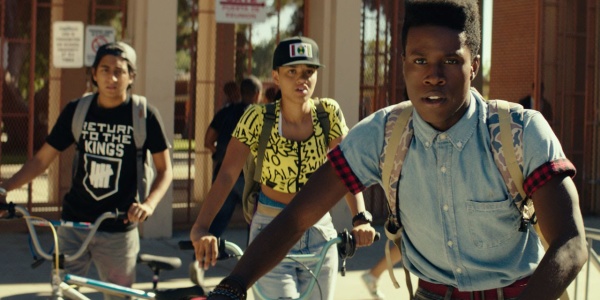
Sundance indie favorite, Dope, directed by Rick Famuyiwa made its theatrical debut a couple of weeks ago. The critically lauded film takes us into the lives of three California teens. These likable, self described nerds, geek out on 90s hip hop (the star Shameik Moore rocks a High Top), play music, deal with teen sexual frustration and navigate the dangers and excitements of their Englewood neighborhood.

The film is a smart look at both the teenage coming of age story and urban lifestyles. It is told through a unique culture lens that requires you literally have to be “dope” to get Dope. It drops you into a particular cultural context and dares you to keep up. It is clearly created by and for those who will understand its cultural intricacies but is inviting enough that any engaged and empathetic audience can join the adventure. Dope, gives a beautiful formula for the relationship between local, specific expression and larger cultural communication. It takes a lot of patience and genuine engagement to get this path right and Dope gives great insight into how to do it.

Paris is Burning, created by filmmaker Jennie Livingston, chronicles the life and times of NYC’s African American and Latino gay and transgender community and their identification with ball culture. This film is an in depth look at a world that was so far outside of the mainstream, and was driven solely by its participants desire to create world for themselves. It is a spectacle in the finest form of creativity, passion and desire to be oneself but countered with an equal desire to be seen and heard.

Watching this movie, you are forced to ask yourself, could something this distinct and commercially unbound manifest itself in today’s market saturated culture? Could the search for more lucrative brand opportunities kill any cultural expression before it even gets a chance to find its own legs? These questions lead us to believe that we need a new set of rules when we think about brand engagement in cultural spaces.

Culture by its nature is difficult to define though it is almost universally accepted as an important part of our social and corporate lives. We often discuss culture and its relationship with brands and their desire to connect with audiences. Most recently here and here. Noted author and anthropologist, Grant McCracken does a great job of parsing the challenges of identifying culture and its importance in a blog post earlier this year. These lines immediately leapt out:

Normally, culture supplies the meanings and rules with which we understand and navigate the world. And normally, it does this invisibly, effortlessly, in real time. We don’t sense culture operating in us. It just does. It’s like language; it’s just there.

But sometimes culture is a little shaky. It has found a world it can’t quite render or organize. And when that happens, wonderful things happen. We understand that we are no longer under “strict instructions.” We are no longer the captive of meanings made. We are now living in a world where meaning and rules are up for grabs.”

McCracken is correct. We like to say change is created on the margins. This is essentially ideologically similar to the idea of no longer having strict instructions. This is the essence of creating something new, having a world that is unclear made clear by new cultural norms. Creative’s, miscreants and other people of that sort are very good at this because they often need this skill to survive. Or at the very least this skill allows them to make sense of the world around them. Brands however, are less good at this because they are by definition organizations of hierarchy and structure. They can however be cultural allies, and that is where the Cultural Prime Directive comes into play.

The Prime Directive is a reference from the Star Trek Universe. It is general order #1 for Starfleet and is considered one of the guiding principles of the United Federation of Planets. Simply put, the Prime Directive prohibits the Federation from interfering with new cultures or playing an active role in their development. The purpose is to allow societies to develop at their own pace without interference by those who have (usually technological) advantages. Now this does not mean that culture creators are disadvantaged players but relative to corporate players their intent can be outmuscled and gentrified. A Brand Prime Directive will set the stage for brands to be cultural allies without being cultural gentrifiers. We will outline principles and corresponding rationale that can serve as a blueprint for both strategic and behavioral shifts.

Do No Harm – This is where it begins. Brands must become allies of cultural movements. They can’t control them or co-opt them. They must resist the industrial age notion of ownership and instead embrace a stewardship role ensuring that these movements can benefit from patronage.

Reevaluate Your Time Horizon – The old adage says, anything worth doing is worth doing well. Which also means it should be done with care. Care means time. In our current quarter-by-quarter “Wall Street-ification” corporate viewpoint time is seen as the enemy. Every program, every initiative must work immediately or it is scrapped and replaced with something newer, something shinier. Often with the same mixed results. Brands must engage with a time horizon that encourages true organic cultivation of culture.

Be Brave -Long term thinking and cultural insight require courage. Not everything can be wrapped in a bow of analytics and “cool hunting”. Brands must be okay with allowing cultural movements to “simmer”. Only then can they establish the right relationships at the right time. In short this requires taking deep breaths and being bold.

Love Centered Revolution“At the risk of seeming ridiculous, let me say that the true revolutionary is guided by a great feeling of love. It is impossible to think of a genuine revolutionary lacking this quality.” Che Guevara

Revolutionary Che Guevara can be considered our first Chief Cultural Officer. Centering a revolution on the concept of love is well…revolutionary. Love as the predominant decision making tool rather than fear will allow brands to exercise a new found freedom to engage with culture.

With this skill set, and attitudes for approaching culture, brands can align, learn from and facilitate, instead of distort, rush and homogenize. Brands are the Medici’s of today’s world and they need the wisdom of the Cultural Prime Directive to guide their actions and frames. With this approach culture can reemerge and brands can be in target. Or put in a “dope” way: “play your position”.


I Am Not a Business, Man!

I Am Not a Business, Man!

Written by Philip McKenzie and Michael Brooks

“This ain’t no tall order, this is nothin to me
Difficult takes a day, impossible takes a week
I do this in my sleep,
I sold Kilos of coke, (so?) I’m guessin’ I can sell CD’s
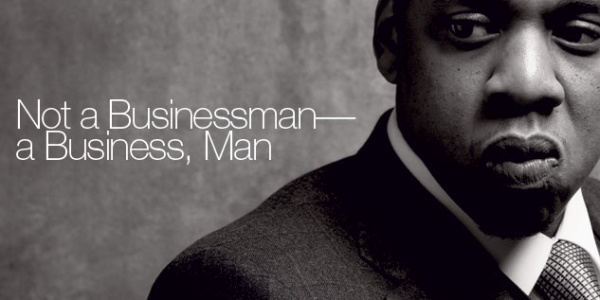
I’m not a businessman; I’m a business, man
Let me handle my business, damn!” – Jay-Z, Diamonds from Sierra Leone (remix)

The above quote from Jay-Z is not only a great example of the type of clever wordplay the rapper is known for; it also explains the guiding idea of our times. Jay-Z, isn’t simply a successful musician or even entrepreneur, instead he is an embodiment of business itself. This is no simply braggadocio, Jay-Z in that one line has reversed engineered what corporations have long sought to do which is have themselves classified as people. Jay-Z is a person heralding himself as a corporation. In today’s economy it isn’t just Jay-Z who is a “business, man” you are too, and with respect to Jay’s lyrically capacity this is bad news for our economy, social and ecological lives. But, first back to Jay.

Given his rags to riches story, and his extreme financial success this boast is one of pride. He has beaten the odds and achieved what few ever could. This is a very traditional American narrative wrapped in Jay-Z’s own particular charisma. But, the line goes deeper than rags to riches and points to a market philosophy that has created mass insecurity, skyrocketing inequality and forced each of us to define personal brands and identities in a competitive and complex marketplace. This philosophy and decades of Neo-liberal policy has made our existence as mini-businesses rather than human beings more and more a reality.

Corporations loom larger than ever in our national discourse. Huge multinationals dominate not only our economic reality but our social reality as well. In the past, a corporate job came with stability and benefits (healthcare, pensions). In an economy still dealing with a new corporate reality post-2008 meltdown, that stability is a thing of the past. Not only did the crisis not reign a runaway corporate sector it broadly reinforced its power.

Corporations in their current incarnation leave more and more of their workforce unprotected with no sign of that trend reversing. Our public policy discourse advocates continued dismantling of the social welfare state leaving citizens with fewer options. Even those businesses that proclaim to “disrupt” the old way of doing things are more of the same. The so-called “Sharing Economy” populated by companies such as Uber, Lyft, AirBnB and others often find themselves aligned with those whose rallying cry is de-regulation at all cost. As the marginal cost of production nears zero are these companies best equipped to provide long term viable work. And how are we defining viable? Is it merely an economic measurement i.e. minimum wage/salary or does it address the quality of our work. Are we doing work that is meaningful not only to ourselves but to the world that we live in.

Where does that leave us? How does one compete in an environment when we are all charged with becoming a business? The implication of this on our psychological, physical and financial well-being is precarious at best.

If we are to assume we are businesses, then we are in a constant state of branding and product launch. Even if that product is us. In a zero-sum capitalist model how do we collaborate if each of us is running their own going concern? The popular edict that triumphs business success over all else is problematic when applied to human beings. The same rules don’t apply, nor should they.

We should not be driven by the whims of a marketplace that favors the monied, the privileged and the powerful. After all, if a business fails we are taught a better business will take its place. But what about those of us in our society who are “failing”? Absent employment options, social services, educational opportunities we cannot merely write them off as poor corporate citizens. In order to confront increasingly daunting social realities we must not reject our humanity instead we should unapologetically embrace it. Technocrats want to reduce us to streams of data removing us from our flesh and blood selves. This too must be rejected. Adopting the language of the powerful is not by default an empowering act. We are in the midst of writing an incredible new story capturing how we see ourselves and the world around us. One of the first chapters must be to reject the notion that we, as a common humanity, are a business, man!

Why if you’re talking about ROI you’re not talking about culture

I have been giving this quite a bit of thought over the last few years since I live firmly in the “culture space”. As the curator of a global conference, I spend most of my time attempting to understand the role that culture plays in our collective world. My attempt to do goes hand in hand with my accepting that the definition of culture stands on constantly shifting ground. Culture can mean the art and creativity of a particular community or the social conventions of an organization as well as the larger societal behavioral trends. Each of these, and more, can be relevant when discussing culture. But for simplicity, I am going to focus on culture as defined as the groundswell of music, media, and art forms that people share in a particular place or time. Institutional players, often in the form of brands (notably but not exclusively CPGs), look to gain entry into the culture space, as they believe, rightly so, it will drive consumer loyalty and engagement. Facing a wide range of options, ROI (Return on Investment) is the chosen metric most often used to assign value to a potential project. The reliance on ROI, however, to determine the value of a project is commonplace and I would argue has no place in a conversation about culture.

In my prior life, I spent years working for Goldman, Sachs. I attended business school with a focus on Finance. I left the world of Wall Street, a world filled with all sorts of arcane financial measurement including ROI, only to find myself right back in the same type of conversation in the culture space. When ROI is mentioned more frequently in a music conversation than it is on a trading desk we have a problem. ROI can be a useful measure when comparing one investment alternative (or opportunity) to another but I find it less effective when measuring cultural impact. Ultimately, this is what makes culture so damn frustrating. We intrinsically know culture is important to us but we can’t quite put a finger on why. Brands know they must be in the culture space but very rarely know how to do so effectively. Hence the reliance on co-opting financial measurements for use in a space that is at its most basic human and emotional. Its very nature defies the type of measurement that financial models rely on. So why is ROI thrown about so frequently? The answer is because it’s easy and convenient. If you can assign a measurement (even a flawed one) to a variable it makes your decision making process somewhat justifiable. The dirty secret about ROI, whether in a financial setting or not, is that it is only as good as the inputs that make up the ratio. Additionally one can modify ROI to suit your specific purposes, it all depends on what is included as return and costs. So a measurement that is held up as unassailable it actually quite subjective. Is this the most effective way we have to gauge impact for something as vital as understanding culture and how we interact with it?

Culture is messy, hit & miss, alluring and intoxicating. Culture drives our conversations and often times our passions. It encompasses music, film, visual arts, fashion and beyond. It’s easy to understand why brands would want to play a role in these multiple worlds. What is the best way to accomplish that without being perceived as an interloper? That remains the central debate but whatever the answer I know it does not involve dissecting cultural opportunities with an arbitrary method like ROI.

Diversity: Lip Service Is Not Enough

Diversity: Lip Service Is Not Enough

Diversity is a maligned word depending on its use and context. If diversity is being used to describe a set of experiences that can potentially add value then it is almost unequivocally a good thing. Recruiters and companies are constantly touting how much they value candidates that can pull from a host of diverse experiences. Diverse life experiences are also heralded as being part of the makeup for living an “interesting life”. The individual who has climbed mountain peaks, bungee jumped & partied in exotic locales is perceived as having achieved a diverse mix of experiences that make for a potentially eclectic worldview. We can vary on degree, but the idea that this type of diversity is generally positive is clear. Switch the focus to diversity among people, whether via race, gender, sexual orientation, etc. and the slope becomes more slippery. We might agree in some vague notions diversity might be a good thing, but outside of a rainbow colored room, how “good” is it? If various groups and individuals assign a certain level of importance to the principle of diversity how does it happen so rarely? I believe, this disconnect occurs because (1) failure to highlight and promote how diversity adds measurable value in professional, academic and creative circles and (2) disingenuous “champions” of diversity whose agenda seeks to support the status quo rather than upend it.

An honest and effective commitment to diversity requires heavy lifting. It requires that individually or as an organization there is recognition that diversity is not a “numbers game” but a “values game”. If the assumption is that a diverse community makes us smarter and better then it must be part of the DNA of your organization. Values are our guiding principles, and diversity as a value must be baked into the mix of other principles that are deemed important. This will ensure that on all levels diversity is taken into account and is part of the planning, strategy, and execution vital to the success of the organization.

Many so-called proponents of diversity are actually ill equipped or disinterested in contextualizing diversity as a conversation around values rather than representation. I spent the formative years of my post-MBA career working on Wall Street at the arguably premiere firm, Goldman, Sachs. The firm aspired to a diverse workplace but like almost every Wall Street firm (and most of the Fortune 500 as well) fell well short of their ambition. These gaps only widened at the senior level. I remember as a young college student looking up the “Top 10 Blacks on Wall Street” and then my dismay at realizing almost 6 years later virtually no change in that list. The “Highlander Effect” was firmly in place and it was clear the prevailing notion was “there can only be one” when it came to diversity. Some progress has been made but not nearly enough relative to our lip service regarding the importance of diversity. Let’s be clear, Wall Street is an easy scapegoat but across almost all corporate America the story is the same, no one is above critique. Often the supporters of diversity are merely advocating for a few more seats at an exclusive table. In essence, they become a select few invited into the conversation while the underlying system remains unchanged. It would make more sense to question whether the table is worth sitting at in the first place. If the status quo is not prepared, capable or willing to have a conversation that elevates diversity then we risk more wasted energy. We have to build a new “status quo” where those who truly value diversity (in the DNA) are supported. There is evidence across the board that diversity is important if we want organizational optimization, just read here, here and here. If we accept this premise, then lip service not only falls short but also is harmful to the advancement of diversity. It reinforces the self-serving behavior of those who trumpet diversity for the many while solely interested in the diversity of the individual…themselves.

These are remarkable times; transparency and access to information allow us to know more than ever about the people and organizations we interact with. More frequently, people around the world are making values based decisions. They are looking to align their personal choices with others who share their value system. This offers an incredible incentive to advance diversity as a core value and truly move the dial for the type of inclusion that will benefit everyone.

Gatekeepers vs. Gatecrashers: Our Global Theme

Gatekeepers vs. Gatecrashers: Our Global Theme

New York, NY – It’s a pleasure to announce the theme for our upcoming global Influencer Conference series. Developing a theme takes time, and countless fits and starts until you land on a concept that “feels right”. In order to accomplish that, the theme must be relevant to all our audience, our partners and align with our values. I think we have managed to do that and much more.

Our theme is “Gatekeepers/crashers: Thriving or Dying?” You can read our descriptive brief here:

The advent of technology and digital media was supposed to herald the end of the age of gatekeepers. The 21st century promised the democratization of communication and access.
Now, almost 15 years into a new century, it begs the question whether that has that truly been the case? Has the power and privilege of gatekeepers subsided or, has the expansion of technology actually had the opposite effect, increasing their reach and power?

For all of the talk of the democratization of the creative process, gatekeepers are more firmly entrenched than ever. How do creators of arts based culture navigate and succeed, as the gates get higher? How do well-meaning gatekeepers connect to and enhance existing cultural ecosystems? We pull the covers back and reveal the true machinations behind culture, commerce and influence by bringing gatekeepers and gatecrashers face to face…a modern day showdown between new age Visigoths and their roman emperor counterparts. 

Friction between gatekeepers/crashers lies at the center of our creative, social, and economic lives. In fact, one could argue as sector and industry designations blur it is more of a challenge to determine who serves which function. In fact, one could argue that at different times and under different circumstances organizations and individuals can wear both hats.

The recent Supreme Court decision of McCutcheon v. FEC and the F.C.C’s flagging interest in protecting net neutrality highlight how precarious the common interest are relative to corporate design. Cultural spaces are not immune as music, film, and other creative endeavors have more participants than ever giving the appearance of democratization even as they wrestle with fewer effective channels to gain traction and attention for their work. Even an artist as prolific as Kanye West feels constrained in his creativity. In an interview with radio/TV Host Sway, Mr. West details the frustration he encounters dealing with gatekeepers. The back and forth between the two men, which is sometimes contentious highlights the yin and yang between creativity, commerce and access. This brought home how important this is. If a globally relevant artist like Kanye is dealing with these issues, what about the rest of us?  In another telling quote Kanye West says this

“It’s mixing creativity with the fight like an athlete. Like it’s okay for the athletes to fight and push it, but they want the creative people to shut-up and be quiet. But these are the people with the real ideas that can actually change, can reorganize, can design cities, can restructure a curriculum, you know, can make life easier. And that’s the part of the game I want to be in: the making life more awesome.” October 28, Los Angeles’ 97.1 AMP Radio

“Creatives” are fighting to be heard, but who are they fighting against (or for), and why? Over the next few months through salons, essays, and finally our global conference we’ll confront the shifting landscape between gatekeepers/crashers across industry and creative disciplines in order to map our collective future.

Welcome to the journey.

The Myth of Scarcity

The Myth of Scarcity

“Life is this simple: we are living in a world that is absolutely transparent and the divine is shining through it all the time. This is not just a nice story or a fable, it is true. ” Thomas Merton

There just doesn’t seem to be enough. Enough time, enough money, enough of this, or enough of that. If you’re like most of us, with long daily “to-do” lists, and seemingly endless appointments and obligations it seems as if there is never enough time to do the things we need to. In many ways, we have become conditioned to believe that the things we need most are in short supply. It’s important to address these feelings of scarcity because in turn it will effect how we view the world and our place in it. If we internalize this idea that the things we need are in short supply it supports the current zero sum mentality you find everywhere. Like an oxygen-depleted tank we begin to take short breaths with our very lives. Preferring to hoard for fear of not having enough. A win for you, in the zero sum model, becomes a loss for me. In an environment of perceived scarcity there is no room for collaboration or authentic connection. It is you against me and vice versa. This is a dangerous worldview as it restricts our solutions to real problems to the existing broken paradigm. If we are to make substantive changes to how we construct our perspectives we must address the myth of scarcity.

In reality, resources are not scarce at all. It is our warped perception that makes it appear so. On a macro level, the planet is more than capable of supporting our needs. Waste rather than scarcity is a far more significant problem even with something as serious as our food supply. In the marketing/advertising game, lack of budget (client mandated scarcity) is hardly a problem as global adverting spends reached an all time high in 2012. So if the facts don’t support scarcity then what’s gone wrong? Simply put, our zero sum attitude, fueled by perceived scarcity prevent us from combining intellectual, physical and economic resources for fear of “losing”. If you perceive my success as being opposed to yours how can we partner to create something new that could actually be mutually beneficial.

The world is bountiful and we should view it through those eyes. The things we need to make our lives productive and worthwhile are here in abundance. Love in all its facets, love for each other, love of what we do, love of our potential to create great things are all overflowing. We need only to embrace a different outlook and throw off this notion of scarcity. This single act is not a cure all. But it does allow us to begin to build new processes, new institutions with a clean slate. After all, what is there to be afraid of if there is nothing to lose?

Feminine Values & Gender

Feminine Values & Gender

Each day I feel there are new conversations and opinion pieces that tackle the idea of feminism and what it means to have an inclusive society. I have good friends that do great work in this arena advocating for the inclusion of women and their perspectives in a myriad of fields that currently do not include much diversity. I applaud and support those efforts but I do believe we need to shift the conversation in a different direction. Instead of seeking out representation based on gender we need to focus on representation based on values. The idea of promoting feminine values, among them empathy, collaboration, and sharing, in order to create better institutions is critical to move the world forward to a more inclusive and just future.

When I was a kid my mother had an old saying “Your color isn’t always your kind”. What this simply means is that just because someone looks like you doesn’t mean they are like you. These flimsy shells of different colored skin and boy or girl parts that we obsess about only tell part of the story. They are easy identifiers that we all use to assign group identify and superficial behavioral traits. We must go deeper and establish a link to our values. The beliefs that we hold dear and align ourselves with carry more weight than almost anything else we encounter. It is increasingly important to find, connect and share with those who embody the same values. In the case of feminine values, the challenge is if we triumph only gender we assume that biological similarity will equate to shared perspective. This is not always the case.

The recent work by author/consultant John Gerzema “The Athena Doctrine” researches these values from a global perspective. He interviews men and women who subscribe to feminine values to build coalition and drive change. The work of Leonard Schlain examines our philosophical and cultural history and relationship with femininity in his seminal work The Alphabet Versus the Goddess. Both authors frame their work from a values based construct rather than a gender based construct.

During our upcoming Influencer Conference NYC, we will be discussing feminine values in a conversation titled Embrace the X: How Feminine Values Will Save The World. We invite you to join us in this discussion by registering for Influencer Conference NYC this coming Nov 6th – Nov 8th.