


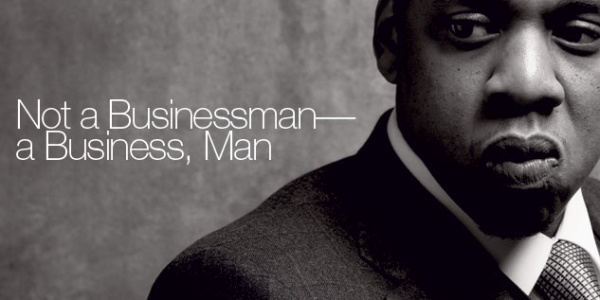
I Am Not a Business, Man!
Written by Philip McKenzie and Michael Brooks
“This ain’t no tall order, this is nothin to me
Difficult takes a day, impossible takes a week
I do this in my sleep,
I sold Kilos of coke, (so?) I’m guessin’ I can sell CD’s
I’m not a businessman; I’m a business, man
Let me handle my business, damn!” – Jay-Z, Diamonds from Sierra Leone (remix)
The above quote from Jay-Z is not only a great example of the type of clever wordplay the rapper is known for; it also explains the guiding idea of our times. Jay-Z, isn’t simply a successful musician or even entrepreneur, instead he is an embodiment of business itself. This is no simply braggadocio, Jay-Z in that one line has reversed engineered what corporations have long sought to do which is have themselves classified as people. Jay-Z is a person heralding himself as a corporation. In today’s economy it isn’t just Jay-Z who is a “business, man” you are too, and with respect to Jay’s lyrically capacity this is bad news for our economy, social and ecological lives. But, first back to Jay.
Given his rags to riches story, and his extreme financial success this boast is one of pride. He has beaten the odds and achieved what few ever could. This is a very traditional American narrative wrapped in Jay-Z’s own particular charisma. But, the line goes deeper than rags to riches and points to a market philosophy that has created mass insecurity, skyrocketing inequality and forced each of us to define personal brands and identities in a competitive and complex marketplace. This philosophy and decades of Neo-liberal policy has made our existence as mini-businesses rather than human beings more and more a reality.
Corporations loom larger than ever in our national discourse. Huge multinationals dominate not only our economic reality but our social reality as well. In the past, a corporate job came with stability and benefits (healthcare, pensions). In an economy still dealing with a new corporate reality post-2008 meltdown, that stability is a thing of the past. Not only did the crisis not reign a runaway corporate sector it broadly reinforced its power.
Corporations in their current incarnation leave more and more of their workforce unprotected with no sign of that trend reversing. Our public policy discourse advocates continued dismantling of the social welfare state leaving citizens with fewer options. Even those businesses that proclaim to “disrupt” the old way of doing things are more of the same. The so-called “Sharing Economy” populated by companies such as Uber, Lyft, AirBnB and others often find themselves aligned with those whose rallying cry is de-regulation at all cost. As the marginal cost of production nears zero are these companies best equipped to provide long term viable work. And how are we defining viable? Is it merely an economic measurement i.e. minimum wage/salary or does it address the quality of our work. Are we doing work that is meaningful not only to ourselves but to the world that we live in.
Where does that leave us? How does one compete in an environment when we are all charged with becoming a business? The implication of this on our psychological, physical and financial well-being is precarious at best.
If we are to assume we are businesses, then we are in a constant state of branding and product launch. Even if that product is us. In a zero-sum capitalist model how do we collaborate if each of us is running their own going concern? The popular edict that triumphs business success over all else is problematic when applied to human beings. The same rules don’t apply, nor should they.
We should not be driven by the whims of a marketplace that favors the monied, the privileged and the powerful. After all, if a business fails we are taught a better business will take its place. But what about those of us in our society who are “failing”? Absent employment options, social services, educational opportunities we cannot merely write them off as poor corporate citizens. In order to confront increasingly daunting social realities we must not reject our humanity instead we should unapologetically embrace it. Technocrats want to reduce us to streams of data removing us from our flesh and blood selves. This too must be rejected. Adopting the language of the powerful is not by default an empowering act. We are in the midst of writing an incredible new story capturing how we see ourselves and the world around us. One of the first chapters must be to reject the notion that we, as a common humanity, are a business, man!