

Love

Throwing Pebbles

Throwing Pebbles

“What we would like to do is change the world–make it a little simpler for people to feed, clothe, and shelter themselves as God intended them to do. And, by fighting for better conditions, by crying out unceasingly for the rights of the workers, the poor, of the destitute–the rights of the worthy and the unworthy poor, in other words–we can, to a certain extent, change the world; we can work for the oasis, the little cell of joy and peace in a harried world. We can throw our pebble in the pond and be confident that its ever-widening circle will reach around the world. We repeat, there is nothing we can do but love, and, dear God, please enlarge our hearts to love each other, to love our neighbor, to love our enemy as our friend.”

Dorothy Day

“We have all known the long loneliness and we have learned that the only solution is love and that love comes with community.”

Dorothy Day

I have only come to know about Dorothy Day and her work very recently as I began reading “All The Way To Heaven: The Selected Letter of Dorothy Day”. This work traces her writings via various letters over her career as a peace activist, social activist, and theologian. Though some of her opinions might seem dated by our standards (she had strict ideas around family structure and sexuality) what I have been touched by was her unwavering belief that we can change the world we live in for the better. Her beliefs are rooted in her Catholicism but find a more universal appeal in the tent of love and fellowship. The above two quotes embodied these concepts most directly and have stayed with me for days, as I wrestled with them. Love as a societal force has been advanced by revolutionaries as varied as Jesus, Bayard Rustin, Martin Luther King, Jr, Mother Teresa and John Lennon. The love advanced by these (and others) was not in the strictest terms romantic, it was a public love that can be best described as compassion or empathy. This seemingly timeless thread of love as a force of change running through history is beautiful and hopeful. Our hearts are an inexhaustible well with the capacity to love so much, from the mundane to the ascendant surely if properly calibrated we can move the dial on societal ills. The challenges we face as a species are daunting. For those of us who bend toward cynicism the weight of wanting to drive real change but not knowing how can be crushing. Maybe the inequity that seems ever present is the normal way of thing? Is a world that can appear cruel and unfair merely the status quo? Thoughts like these can consume you unless you turn angst into action and the resulting energy toward love and community, a natural extension of compassion and empathy. During Influencer Conference NYC 2012, I moderated a conversation titled Love as Public Policy, which I hoped, would spark a conversation demanding a public policy informed by compassion rather than special interest. We launched a pebble that day, and over the couple of years since that talk have launched a few more. Many organizations and individuals globally who share a commitment toward systemic change are launching their pebbles as well. We do this in the hope of creating a community empowered by love that will form the “ever widening circle” described by Ms Day. Those pebbles, big and small, have the power to become an avalanche and with it create a dramatic shift in how we live and perceive the world around us. So do not scoff at the notion of the transformative power of love. Instead, extend your compassion to all who need it, embrace and keep each other and create the world we want by sheer will.
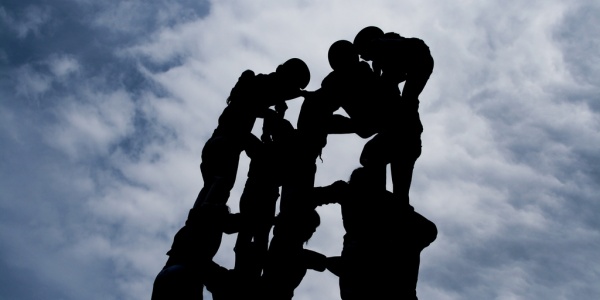
In Each Other We Trust

In Each Other We Trust

When I was in business school at Duke University we didn’t talk much about the idea of trust. We emphasized teamwork a ton, and actually the “Team Fuqua” culture was a huge part of my decision to attend school at Duke and I loved every minute. One could say that the idea of a team culture implies a trusting culture. After all, can teammates work effectively if they do not trust one another? Lack of trust between teammates can make it a harder road but it won’t necessarily doom the team to failure. The reality is many teams in academia or in traditional workplace environments are hoisted upon us. We don’t make the choice to team up, so the team whether dysfunctional or not must find a way to produce “something” even if that output is not the potentially best result. My point is that even in a leading institution like Duke, with a strong culture of teamwork doesn’t directly address the concept of trust. This is not unusual as a discussion of values, whether trust, sharing, collaboration, love are not usually front and center in the “alpha-type” construct of business and its training ground, business school.

It is outside of a traditional corporate environment that trust must be one of the most important working facets of any relationship. In fact, it is likely #1. Relationships are ultimately about how we choose to transact with one another. The classic language of “give and take” is a simplistic rendering of a relationship. Beginning a relationship with a foundation of trust has the power to place into motion meaningful actions that will drive the success of that transaction. Too often we think about our transactional future in terms of devices, speed of transfer of data, or the language of contracts. Our transactional future turns most significantly on how we choose to interact with one another. That begins with whether or not we value trust as a key component in our interactions.

Trust is both the easiest and scariest thing one person can do. Trust requires you to be open. If you are open, you must be vulnerable. Our fear of being vulnerable comes from a fear of being hurt, or taken advantage of, or duped. If we confront this fear we will find we have the capacity to be comfortable within our vulnerability and draw strength from it. Trusting becomes an active choice in the faith of other human beings to not harm us. Our transactions can now come from a place of bravery rather than fear providing a much stronger foundation. The old model of transactions is fear based. We enter relationships, thinking about what we have to lose, how can we get hurt, how do we protect against the “down-side”? Trust makes us work to keep the fear at bay. Bad things can and always will happen but it shouldn’t color the way in which we treat one another. In an increasingly fragmented creative world, it should be a core operating strength that smaller organizations work together. Big organizations have the advantage of resources and scale. Smaller organizations should build coalitions of trust in order to create better work and establish better working economies for themselves. Instead smaller organizations often act like serfs toiling on the land of the corporate landowner. At a time in history when our goals have never been more aligned many are resistant to scrapping the old “fear based” ways of working and creating. If we can embrace trust as a starting point to forge a different transactional future we can go a long way toward creating a new normal that is braver than the old.